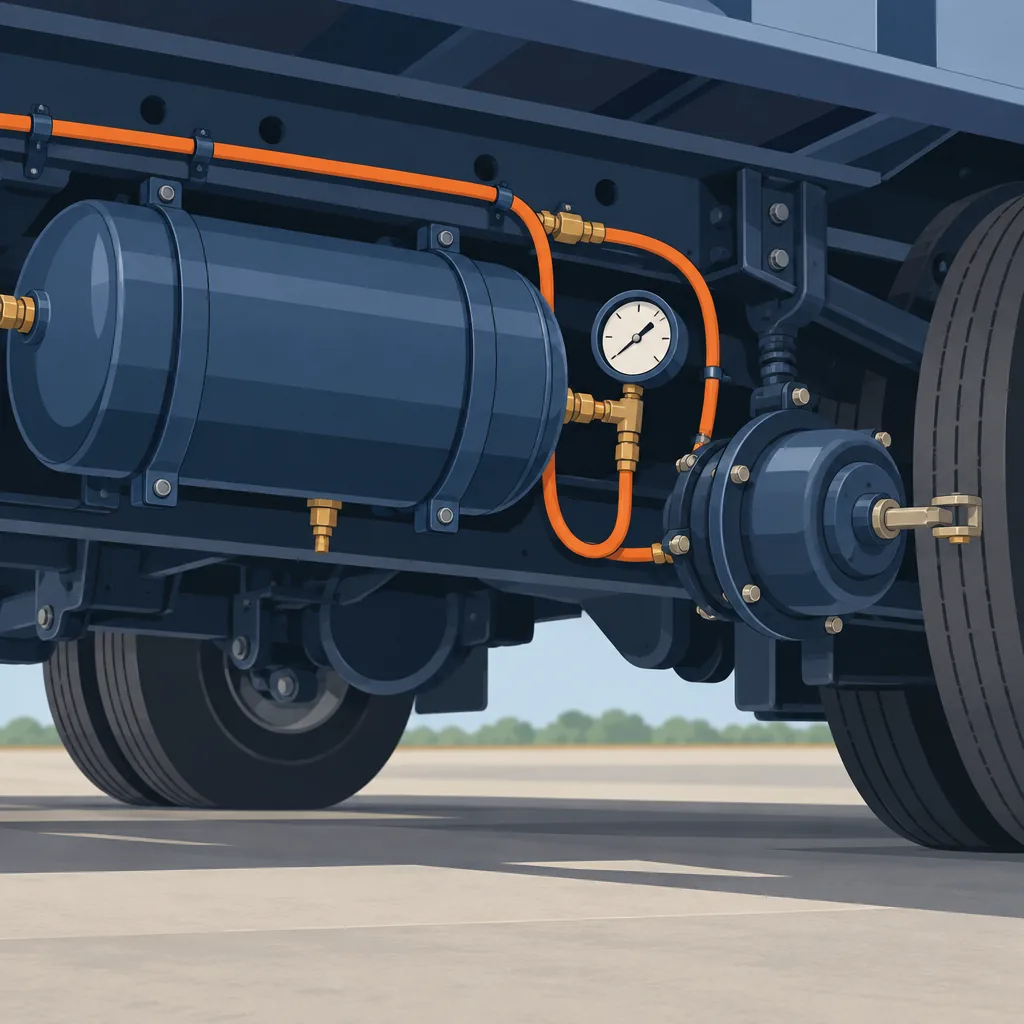
Question 1 of 25 · Compressor
What is the purpose of an alcohol evaporator?
-
A.
Reduce alcohol in the driver's system
-
B.
Reduce risk of frozen brake valves and lines in cold weather
-
C.
Improve fuel economy
-
D.
Lubricate the air compressor
Correct answer: B.
Alcohol injected into the air system reduces freeze-up risk in cold conditions.
Question 2 of 25 · Inspection
How do you test the low pressure warning signal?
-
A.
With the engine off, pump the brake pedal until the signal activates (must come on at 60 psi or above)
-
B.
Drive the vehicle to lose pressure
-
C.
Open the air tank drain valve briefly
-
D.
Push the parking brake control
Correct answer: A.
Pump the brake to lower pressure; warning must come on at 60 psi or higher.
Question 3 of 25 · Gauges
What gauge tells you the air pressure being delivered to the brakes?
-
A.
Application pressure gauge
-
B.
Supply pressure gauge
-
C.
Speedometer
-
D.
Tachometer
Correct answer: A.
The application gauge shows pressure being applied to the brakes when the pedal is pressed.
Question 4 of 25 · Gauges
You should know your vehicle is properly equipped with which gauge?
-
A.
Two air pressure gauges (or one with two needles) showing pressure in primary and secondary tanks
-
B.
A vacuum gauge
-
C.
A voltage meter only
-
D.
A coolant gauge only
Correct answer: A.
Dual air systems require gauges for both primary and secondary air supplies.
Question 5 of 25 · Inspection
How do you know that you have an air leak?
-
A.
Pressure drops faster than allowable rate
-
B.
You hear hissing
-
C.
Both A and B
-
D.
The brake pedal feels firm
Correct answer: C.
Pressure dropping faster than allowed and audible hissing both indicate leaks.
Question 6 of 25 · Speed Management
Which of these statements is true about brake fading?
-
A.
Resting brakes does not bring back braking power
-
B.
Brake fade is caused by drums getting too hot
-
C.
Brake fade only affects new vehicles
-
D.
Brake fade only happens with disc brakes
Correct answer: B.
Brake fade results from overheated drums or discs reducing friction and braking ability.
Question 7 of 25 · System Basics
Air brake systems combine three different braking systems. They are:
-
A.
Service, parking, and emergency brakes
-
B.
Hydraulic, parking, and emergency brakes
-
C.
Front, rear, and trailer brakes
-
D.
Disc, drum, and parking brakes
Correct answer: A.
The three are: the service brake, the parking brake, and the emergency brake.
Question 8 of 25 · Emergency Maneuvers
Stab braking includes which of these steps?
-
A.
Apply brakes fully, release when wheels lock, reapply when wheels begin rolling
-
B.
Apply brakes lightly until they fade
-
C.
Pump the brakes rapidly
-
D.
Apply the parking brake repeatedly
Correct answer: A.
Stab braking: full application, release on lockup, reapply when wheels turn again.
Question 9 of 25 · Bobtail
What is bobtail braking?
-
A.
Braking with no trailer attached, when the tractor brakes harder than usual
-
B.
A type of trailer-only braking
-
C.
Emergency braking on doubles
-
D.
A way to test the parking brake
Correct answer: A.
A bobtail tractor (without a trailer) brakes hard because it has less weight on the drive axles.
Question 10 of 25 · Speed Management
Total stopping distance for an air-braked vehicle is made up of:
-
A.
Perception distance + reaction distance + brake lag distance + braking distance
-
B.
Just the braking distance
-
C.
Reaction distance only
-
D.
Brake lag distance only
Correct answer: A.
It is the sum of perception distance, reaction distance, brake lag distance, and braking distance.
Question 11 of 25 · Spring Brakes
What does a "spring brake" mean?
-
A.
A brake that operates only in spring weather
-
B.
A mechanical brake that uses powerful springs to apply the brake when air pressure is lost
-
C.
A specific kind of disc brake
-
D.
A backup hydraulic brake
Correct answer: B.
Spring brakes use powerful coil springs to apply the brakes when air pressure is lost.
Question 12 of 25 · Combination Air
When should the trailer brake hand valve be used?
-
A.
To park the trailer
-
B.
To test the trailer brakes only
-
C.
To stop the entire combination
-
D.
Never to keep the vehicle from rolling
Correct answer: B.
Use it only to test trailer brakes. Never use it to park or as a service brake during normal stops.
Question 13 of 25 · Operation
When the brake pedal is pushed harder, what happens?
-
A.
Brake pedal must be pumped to release
-
B.
More air goes to the brakes; less foot pressure releases air
-
C.
It locks the brakes permanently
-
D.
The brakes do not respond
Correct answer: B.
The harder you push, the more air pressure is sent to the brake chambers.
Question 14 of 25 · Gauges
The supply pressure gauge tells you:
-
A.
The pressure of brake fluid
-
B.
How much air pressure is in the air tanks
-
C.
The trailer brake pressure
-
D.
The temperature of the brake
Correct answer: B.
The supply gauge shows the air pressure available in the storage tanks.
Question 15 of 25 · Inspection
How much air pressure (psi) loss is allowed per minute for single vehicles with the engine off and brakes released?
-
A.
Up to 1 psi
-
B.
Up to 2 psi
-
C.
Up to 3 psi
-
D.
Up to 4 psi
Correct answer: B.
Single vehicles allow up to 2 psi per minute with brakes released; up to 3 psi with brakes applied.
Question 16 of 25 · Spring Brakes
Modulating control valves do what?
-
A.
Drain water from tanks
-
B.
Apply spring brakes gradually using a hand control
-
C.
Open the trailer supply line
-
D.
Switch to emergency brakes
Correct answer: B.
Modulating valves let you apply the spring brakes gradually rather than all at once.
Question 17 of 25 · Compressor
Which of these systems removes water and oil from compressed air?
-
A.
Air dryer
-
B.
Brake chamber
-
C.
Slack adjuster
-
D.
S-cam
Correct answer: A.
The air dryer removes moisture and oil from the air before it reaches the storage tanks.
Question 18 of 25 · Warning Devices
The low air pressure warning device must come on when air pressure in the service tanks falls below:
-
A.
80 psi
-
B.
60 psi
-
C.
50 psi or 1/2 the compressor governor cut-out pressure
-
D.
20 psi
Correct answer: C.
Low pressure warnings activate at 60 psi or less (or half the cut-out pressure on older vehicles).
Question 19 of 25 · Inspection
Which of the following must be checked before operating an air-braked vehicle?
-
A.
Low air pressure warning signal
-
B.
Spring brakes set automatically
-
C.
Air leakage rate
-
D.
All of the above
Correct answer: D.
All of these are required pre-trip air brake checks.
Question 20 of 25 · System Basics
Air brakes use compressed air to:
-
A.
Lubricate the wheels
-
B.
Make the brakes work
-
C.
Cool the engine
-
D.
Increase fuel pressure
Correct answer: B.
Compressed air is the working fluid that applies the brakes in an air brake system.
Question 21 of 25 · Combination Air
What does the trailer hand valve do?
-
A.
Operates only the trailer brakes
-
B.
Operates both the tractor and trailer brakes
-
C.
Engages the parking brakes
-
D.
Lowers the landing gear
Correct answer: A.
The hand valve (trolley valve) controls only the trailer service brakes.
Question 22 of 25 · Parking
When parking a tractor-trailer with spring brakes:
-
A.
Use the trailer hand valve only
-
B.
Use the parking brake only — do not push the brake pedal down to hold the vehicle
-
C.
Press the foot brake and then engage the parking brake
-
D.
Set both brakes simultaneously
Correct answer: B.
Don't push the pedal down because it will cause damage. Set the parking brakes only.
Question 23 of 25 · Tanks
When should you drain the air tanks?
-
A.
Once a week
-
B.
Only when the warning light is on
-
C.
At the end of each working day
-
D.
Once a month
Correct answer: C.
Drain tanks completely at the end of each working day to remove water and oil.
Question 24 of 25 · System Basics
Which of these is NOT a part of the basic air brake system?
-
A.
Air compressor
-
B.
Air storage tanks
-
C.
Hydraulic master cylinder
-
D.
Foot brake valve
Correct answer: C.
Hydraulic master cylinders belong to hydraulic brake systems, not air brake systems.
Question 25 of 25 · Spring Brakes
What does the term "modulating control valve" refer to?
-
A.
A valve to regulate engine RPM
-
B.
A hand-operated valve that gradually applies the spring brakes
-
C.
A device that drains air tanks
-
D.
The trailer hand valve
Correct answer: B.
A modulating control valve allows gradual application of spring brakes for emergency or backup use.
About the Air Brakes Test
The Air Brakes test covers air brake system parts (compressor, governor, reservoirs, drain valves, alcohol evaporator, safety valve, brake pedal, foundation brakes), dual air brake systems, inspecting air brakes, using air brakes (normal stops, emergency stops, parking brakes), and proper procedures for braking on downgrades. If you fail or skip the Air Brakes test, your CDL is restricted to vehicles without full air brake systems.
The North Carolina Division of Motor Vehicles administers this knowledge test as part of its commercial driver license program. To earn the Air Brakes Endorsement on your North Carolina CDL, you need to score at least 20 out of 25 on the official version.
Topics covered on this practice test
- Inspection: 4 questions
- Gauges: 3 questions
- System Basics: 3 questions
- Spring Brakes: 3 questions
- Compressor: 2 questions
- Speed Management: 2 questions
- Combination Air: 2 questions
- Emergency Maneuvers: 1 question
- Bobtail: 1 question
- Operation: 1 question
- Warning Devices: 1 question
- Parking: 1 question
- Tanks: 1 question
How to use this practice test
- Read each question carefully. CDL questions are written precisely — small wording differences matter.
- Click an answer choice to check it instantly — right or wrong, you'll see the explanation right away.
- Read the explanation for every question, even ones you got right. The reasoning is more important than the answer.
- Repeat the test until you score 100%. The questions are deterministic per state, so you can track your improvement over multiple sessions.
- Move on to the other endorsement tests for North Carolina until you're ready for the official exam.
Tips specific to the Air Brakes test
Air Brakes questions test your ability to identify components, follow inspection sequences, and respond to system failures. Memorize the cut-in and cut-out pressures, the low-pressure warning thresholds, the pressure ranges at which spring brakes apply, and the maximum allowable air-loss rates. Many questions have nearly-identical wording, so precision matters.