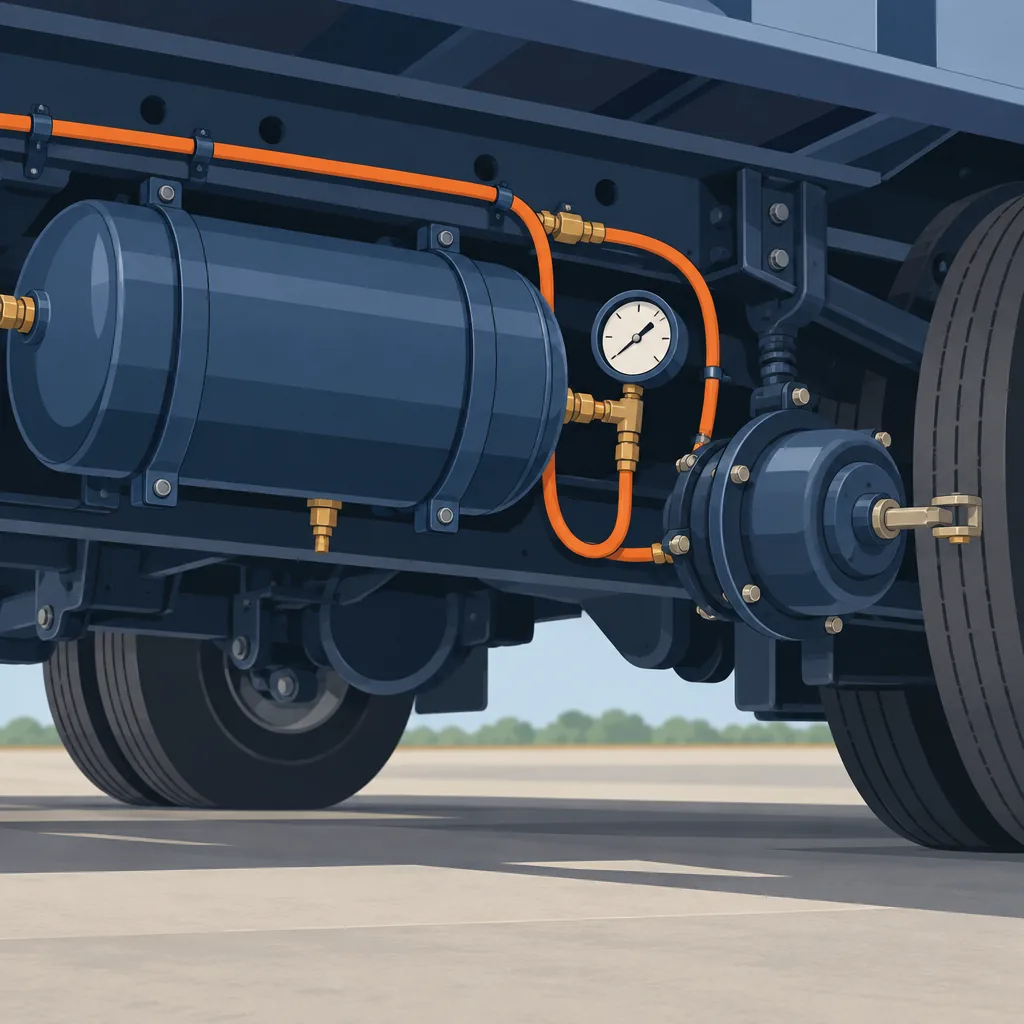
Question 1 of 25 · Spring Brakes
Modulating control valves do what?
-
A.
Drain water from tanks
-
B.
Apply spring brakes gradually using a hand control
-
C.
Open the trailer supply line
-
D.
Switch to emergency brakes
Correct answer: B.
Modulating valves let you apply the spring brakes gradually rather than all at once.
Question 2 of 25 · Speed Management
Why is it important not to over-apply the brakes?
-
A.
Brakes can overheat and fade
-
B.
Brakes will lock and skid
-
C.
You may lose control of the vehicle
-
D.
All of the above
Correct answer: D.
Over-application leads to fade, lockup, skidding, and loss of control.
Question 3 of 25 · Operation
When making a normal stop, what should you do?
-
A.
Push the brake pedal down so you can stop at a safe place and remain in control
-
B.
Pump the brakes
-
C.
Use only the parking brake
-
D.
Use only the trailer hand valve
Correct answer: A.
Apply pressure progressively to come to a smooth, safe stop while maintaining control.
Question 4 of 25 · Spring Brakes
What happens if the air pressure drops to between 20 and 45 psi?
-
A.
Nothing happens
-
B.
The compressor cuts in
-
C.
Spring brakes apply automatically
-
D.
The trailer is released
Correct answer: C.
Spring brakes typically apply automatically in this range, stopping the vehicle.
Question 5 of 25 · Spring Brakes
Where are spring brakes typically NOT found?
-
A.
Front steering axle
-
B.
Drive axles
-
C.
Trailer axles
-
D.
Tractor rear axles
Correct answer: A.
Spring brakes are found on drive axles and trailer axles, not normally on the steering axle.
Question 6 of 25 · Compressor
If the air compressor governor is not working properly:
-
A.
Air compressor may not maintain enough pressure to safely operate the brakes
-
B.
The brakes will work harder
-
C.
Brakes may not release at all
-
D.
There is no impact on safety
Correct answer: A.
A faulty governor can cause low system pressure or over-pressurization, both unsafe.
Question 7 of 25 · Parking
When parking a tractor-trailer with spring brakes:
-
A.
Use the trailer hand valve only
-
B.
Use the parking brake only — do not push the brake pedal down to hold the vehicle
-
C.
Press the foot brake and then engage the parking brake
-
D.
Set both brakes simultaneously
Correct answer: B.
Don't push the pedal down because it will cause damage. Set the parking brakes only.
Question 8 of 25 · Combination Air
When should the trailer brake hand valve be used?
-
A.
To park the trailer
-
B.
To test the trailer brakes only
-
C.
To stop the entire combination
-
D.
Never to keep the vehicle from rolling
Correct answer: B.
Use it only to test trailer brakes. Never use it to park or as a service brake during normal stops.
Question 9 of 25 · ABS
If the ABS warning light comes on, you should:
-
A.
Stop driving immediately
-
B.
Continue, knowing brakes still work — but ABS may not
-
C.
Pump the brakes constantly
-
D.
Engage the trailer hand valve
Correct answer: B.
You still have normal braking; only the ABS function may be off. Get it fixed soon.
Question 10 of 25 · ABS
Which is true about ABS?
-
A.
It activates only on dry roads
-
B.
It activates only when wheels are about to lock during heavy braking
-
C.
It is the same as anti-skid
-
D.
It eliminates the need for skid recovery
Correct answer: B.
ABS activates only when wheels are about to lock; otherwise the brake system operates normally.
Question 11 of 25 · Compressor
The air compressor governor controls:
-
A.
When the air compressor will pump air into the storage tanks
-
B.
When the brakes are applied
-
C.
When emergency brakes engage
-
D.
How fast the air compressor turns
Correct answer: A.
The governor cuts the compressor in and out to keep the system within its operating pressure range.
Question 12 of 25 · System Basics
Which of the following is NOT in the air brake system?
-
A.
Brake chambers
-
B.
Slack adjusters
-
C.
S-cam
-
D.
Hydraulic master cylinder
Correct answer: D.
Hydraulic master cylinders are part of hydraulic systems, not air brake systems.
Question 13 of 25 · Inspection
When should you check the parking brake?
-
A.
Whenever you start a trip
-
B.
Once a month
-
C.
Only at inspections
-
D.
When the brake warning light is on
Correct answer: A.
Test the parking brake every trip — apply the brake and try to move forward gently.
Question 14 of 25 · Compressor
Brake-system air pressure should build from 85 to 100 psi within:
-
A.
15 seconds in dual systems
-
B.
30 seconds in dual systems
-
C.
45 seconds in dual systems
-
D.
60 seconds in dual systems
Correct answer: C.
Build-up time should be within 45 seconds in dual air systems.
Question 15 of 25 · Compressor
What is the purpose of an alcohol evaporator?
-
A.
Reduce alcohol in the driver's system
-
B.
Reduce risk of frozen brake valves and lines in cold weather
-
C.
Improve fuel economy
-
D.
Lubricate the air compressor
Correct answer: B.
Alcohol injected into the air system reduces freeze-up risk in cold conditions.
Question 16 of 25 · Parking
On a tractor with no trailer attached, the tractor parking brake control:
-
A.
Will lock and unlock the front brakes
-
B.
Will set or release the spring brakes on the tractor
-
C.
Has no function
-
D.
Operates only the trailer brakes
Correct answer: B.
The yellow diamond control sets and releases the tractor parking (spring) brakes.
Question 17 of 25 · Gauges
What gauge tells you the air pressure being delivered to the brakes?
-
A.
Application pressure gauge
-
B.
Supply pressure gauge
-
C.
Speedometer
-
D.
Tachometer
Correct answer: A.
The application gauge shows pressure being applied to the brakes when the pedal is pressed.
Question 18 of 25 · Inspection
What is the air loss rate for combination vehicles with brakes applied?
-
A.
1 psi per minute
-
B.
2 psi per minute
-
C.
3 psi per minute
-
D.
4 psi per minute
Correct answer: D.
Combination vehicles can lose up to 4 psi per minute with brakes applied.
Question 19 of 25 · Inspection
When should you push the brake pedal during the air brake test?
-
A.
Only when the engine is running
-
B.
When checking the compressor
-
C.
When the engine is off, to check that pressure does not drop too quickly
-
D.
During the brake light test only
Correct answer: C.
Apply firm pressure with the engine off to check for excessive air leakage from the system.
Question 20 of 25 · Foundation Brakes
Brake drums (or discs) must not have cracks longer than:
-
A.
1/4 the width of the friction area
-
B.
1/2 the width of the friction area
-
C.
3/4 the width of the friction area
-
D.
Anything is acceptable
Correct answer: B.
Cracks longer than one-half the width of the friction area are a safety violation.
Question 21 of 25 · Inspection
How much air pressure (psi) loss is allowed per minute for single vehicles with the engine off and brakes released?
-
A.
Up to 1 psi
-
B.
Up to 2 psi
-
C.
Up to 3 psi
-
D.
Up to 4 psi
Correct answer: B.
Single vehicles allow up to 2 psi per minute with brakes released; up to 3 psi with brakes applied.
Question 22 of 25 · Speed Management
Air brake lag distance at 55 mph on dry pavement adds about:
-
A.
12 feet to stopping distance
-
B.
32 feet to stopping distance
-
C.
50 feet to stopping distance
-
D.
100 feet to stopping distance
Correct answer: B.
Air brake systems have a lag of about 0.4 seconds, adding roughly 32 feet at 55 mph.
Question 23 of 25 · Tanks
When should you drain the air tanks?
-
A.
Once a week
-
B.
Only when the warning light is on
-
C.
At the end of each working day
-
D.
Once a month
Correct answer: C.
Drain tanks completely at the end of each working day to remove water and oil.
Question 24 of 25 · Parking
Why should you use chocks?
-
A.
When parking on a hill
-
B.
On level ground when leaving the vehicle
-
C.
Whenever brakes might fail or it's required by company policy or law
-
D.
All of the above
Correct answer: D.
Chocks should be used when required to prevent vehicle movement.
Question 25 of 25 · System Basics
Air brake systems combine three different braking systems. They are:
-
A.
Service, parking, and emergency brakes
-
B.
Hydraulic, parking, and emergency brakes
-
C.
Front, rear, and trailer brakes
-
D.
Disc, drum, and parking brakes
Correct answer: A.
The three are: the service brake, the parking brake, and the emergency brake.
About the Air Brakes Test
The Air Brakes test covers air brake system parts (compressor, governor, reservoirs, drain valves, alcohol evaporator, safety valve, brake pedal, foundation brakes), dual air brake systems, inspecting air brakes, using air brakes (normal stops, emergency stops, parking brakes), and proper procedures for braking on downgrades. If you fail or skip the Air Brakes test, your CDL is restricted to vehicles without full air brake systems.
The Idaho Transportation Department — Driver Services administers this knowledge test as part of its commercial driver license program. To earn the Air Brakes Endorsement on your Idaho CDL, you need to score at least 20 out of 25 on the official version.
Topics covered on this practice test
- Compressor: 4 questions
- Inspection: 4 questions
- Spring Brakes: 3 questions
- Parking: 3 questions
- Speed Management: 2 questions
- ABS: 2 questions
- System Basics: 2 questions
- Operation: 1 question
- Combination Air: 1 question
- Gauges: 1 question
- Foundation Brakes: 1 question
- Tanks: 1 question
How to use this practice test
- Read each question carefully. CDL questions are written precisely — small wording differences matter.
- Click an answer choice to check it instantly — right or wrong, you'll see the explanation right away.
- Read the explanation for every question, even ones you got right. The reasoning is more important than the answer.
- Repeat the test until you score 100%. The questions are deterministic per state, so you can track your improvement over multiple sessions.
- Move on to the other endorsement tests for Idaho until you're ready for the official exam.
Tips specific to the Air Brakes test
Air Brakes questions test your ability to identify components, follow inspection sequences, and respond to system failures. Memorize the cut-in and cut-out pressures, the low-pressure warning thresholds, the pressure ranges at which spring brakes apply, and the maximum allowable air-loss rates. Many questions have nearly-identical wording, so precision matters.