Question 1 of 25 · Loading
Why must tanker drivers be careful when refueling?
-
A.
Risk of fire from spills
-
B.
Risk of cargo contamination
-
C.
Risk of overloading
-
D.
Both A and B
Correct answer: D.
Spills can ignite and cargo can be contaminated by fuel.
Question 2 of 25 · Adverse Conditions
What's the safe way to handle a tanker in heavy wind?
-
A.
Slow down and grip steering firmly
-
B.
Speed up to maintain control
-
C.
Use the engine retarder
-
D.
Lock the brakes
Correct answer: A.
High winds destabilize tankers; slow down and steer firmly.
Question 3 of 25 · Vehicle Dynamics
How do drivers minimize side-to-side surge?
-
A.
Avoid abrupt lane changes and turns
-
B.
Take turns wide and slow
-
C.
Use partial loads
-
D.
Both A and B
Correct answer: D.
Smooth, slow inputs and wide turns help reduce side-to-side surge.
Question 4 of 25 · Speed Management
When should tank drivers especially reduce speed?
-
A.
On wet or slippery roads
-
B.
On curves
-
C.
On ramps
-
D.
All of the above
Correct answer: D.
Slow down on wet roads, curves, and ramps — all increase rollover risk.
Question 5 of 25 · Vehicle Dynamics
When is it most dangerous to brake suddenly in a tanker?
-
A.
When tank is partially full
-
B.
When tank is fully loaded
-
C.
When tank is empty
-
D.
When tank is heated
Correct answer: A.
Partial loads create the most surge during sudden braking.
Question 6 of 25 · Loading
Why is it important not to overload tank vehicles?
-
A.
Overloading exceeds weight limits
-
B.
It increases risk of tank rupture
-
C.
It changes vehicle handling
-
D.
All of the above
Correct answer: D.
Overloading is illegal and unsafe; it changes handling and stresses the tank.
Question 7 of 25 · Mountain Driving
What's the proper way to handle a tanker on a steep downgrade?
-
A.
Use lower gears and engine braking with intermittent service brake
-
B.
Coast in neutral
-
C.
Brake hard the whole way
-
D.
Use the parking brake
Correct answer: A.
Lower gears and engine braking; use service brakes intermittently to avoid overheating.
Question 8 of 25 · HazMat Driving
Why is "no smoking" enforced near tankers?
-
A.
Risk of fire and explosion from cargo vapors
-
B.
Cleanliness
-
C.
Tradition
-
D.
OSHA rules only
Correct answer: A.
Vapors can ignite or explode; smoking is prohibited near tankers.
Question 9 of 25 · Emergency Equipment
What equipment must be on a HazMat tank vehicle?
-
A.
Emergency response equipment
-
B.
Spill kits as required
-
C.
Communication devices
-
D.
All of the above
Correct answer: D.
Carry spill response gear, communication, and any other required equipment.
Question 10 of 25 · Tank Types
What's a key difference between compartmented and smooth-bore tanks?
-
A.
Compartmented tanks reduce surge between sections
-
B.
Smooth-bore tanks have less surge
-
C.
They are the same in terms of surge
-
D.
Compartmented tanks are always larger
Correct answer: A.
Compartmented tanks reduce overall surge by limiting movement to each section.
Question 11 of 25 · Inspection
What's the importance of the tank shell's integrity?
-
A.
It contains the cargo and prevents leaks
-
B.
It supports the chassis
-
C.
It absorbs shock
-
D.
It connects to the brakes
Correct answer: A.
A sound tank shell prevents leaks and contains pressure from the cargo.
Question 12 of 25 · Emergency Maneuvers
What's the best approach to handling a flat tire on a tanker?
-
A.
Pull over safely and replace the tire or call for help
-
B.
Continue driving
-
C.
Drive faster to make it to the next exit
-
D.
Stop in the middle of the road
Correct answer: A.
Stop safely and address the flat — driving on it can lead to bigger problems.
Question 13 of 25 · Vehicle Dynamics
What's a key safety feature in modern tankers?
-
A.
Automatic emergency braking
-
B.
Stability control systems
-
C.
Reinforced tank shells
-
D.
All of the above
Correct answer: D.
Modern tankers often combine ABS, stability control, and reinforced shells for safety.
Question 14 of 25 · Adverse Conditions
What's the best practice for starting on slippery roads with a tanker?
-
A.
Accelerate slowly to avoid wheel spin
-
B.
Accelerate quickly
-
C.
Use the lowest gear and slip clutch
-
D.
Use parking brake
Correct answer: A.
Smooth, slow acceleration avoids spinning the drive tires.
Question 15 of 25 · Tank Types
What is a "smooth bore" tank?
-
A.
A tank with internal baffles
-
B.
A tank without internal baffles or compartments
-
C.
A heated tank
-
D.
A two-compartment tank
Correct answer: B.
Smooth-bore tanks have no internal baffles, so liquid surge is unrestrained.
Question 16 of 25 · Loading
What is "outage" requirement for liquids that expand a lot?
-
A.
Larger outage required
-
B.
Less outage required
-
C.
No outage required
-
D.
Outage doesn't depend on the liquid
Correct answer: A.
Liquids that expand more (e.g., LPG) require greater outage in the tank.
Question 17 of 25 · Loading
What is a vapor recovery system?
-
A.
A way to recover heat
-
B.
A system to recover vapors during loading and unloading to reduce emissions
-
C.
An air brake component
-
D.
A backup pump
Correct answer: B.
Vapor recovery captures vapors during transfer to limit emissions.
Question 18 of 25 · Parking
What's the safest place to park a tank vehicle overnight?
-
A.
Designated truck parking areas away from buildings
-
B.
On the highway shoulder
-
C.
In residential areas
-
D.
Anywhere with lighting
Correct answer: A.
Use designated truck parking areas away from people and buildings.
Question 19 of 25 · Adverse Conditions
What's the safe way to handle a tanker on icy roads?
-
A.
Slow down and increase following distance
-
B.
Use chains if required
-
C.
Avoid sudden braking and steering
-
D.
All of the above
Correct answer: D.
Reduced speed, chains where required, and smooth inputs reduce risk on ice.
Question 20 of 25 · Operation
What's the recommended safe braking technique for tank trucks?
-
A.
Apply brakes gradually well before stopping
-
B.
Quick, hard braking
-
C.
Use the engine retarder primarily
-
D.
Brake at the last second
Correct answer: A.
Brake gradually and well in advance — sudden braking magnifies surge.
Question 21 of 25 · Emergencies
What action should a driver take if a tank starts to leak?
-
A.
Stop immediately in a safe area and report the leak
-
B.
Continue to destination
-
C.
Try to close the leak
-
D.
Drive faster
Correct answer: A.
Stop in a safe area, secure the area, and notify the carrier and emergency services.
Question 22 of 25 · Tank Types
What is the purpose of internal baffles?
-
A.
To reduce side-to-side surge
-
B.
To reduce forward and back surge
-
C.
To prevent leaks
-
D.
To increase tank size
Correct answer: B.
Baffles reduce front-to-back surge but do not stop side-to-side surge.
Question 23 of 25 · Mountain Driving
How do drivers control speed on downgrades with tankers?
-
A.
Use lower gears and engine braking
-
B.
Use service brakes only
-
C.
Coast with no brakes
-
D.
Use parking brake
Correct answer: A.
Use proper low gears and engine braking; service brakes only intermittently.
Question 24 of 25 · Vehicle Dynamics
What's the most important thing to remember about driving a tanker?
-
A.
Be aware of liquid surge and high center of gravity
-
B.
Drive faster to maintain schedule
-
C.
Skip pre-trip inspections
-
D.
Ignore weather conditions
Correct answer: A.
Surge and CG awareness are the cornerstones of safe tanker driving.
Question 25 of 25 · Vehicle Dynamics
How can drivers prevent tanker rollover?
-
A.
Reduce speed in curves and ramps
-
B.
Avoid sudden steering
-
C.
Maintain proper load and securement
-
D.
All of the above
Correct answer: D.
Slow speed, smooth steering, and proper loading all help prevent rollovers.
About the Tank Vehicles Test
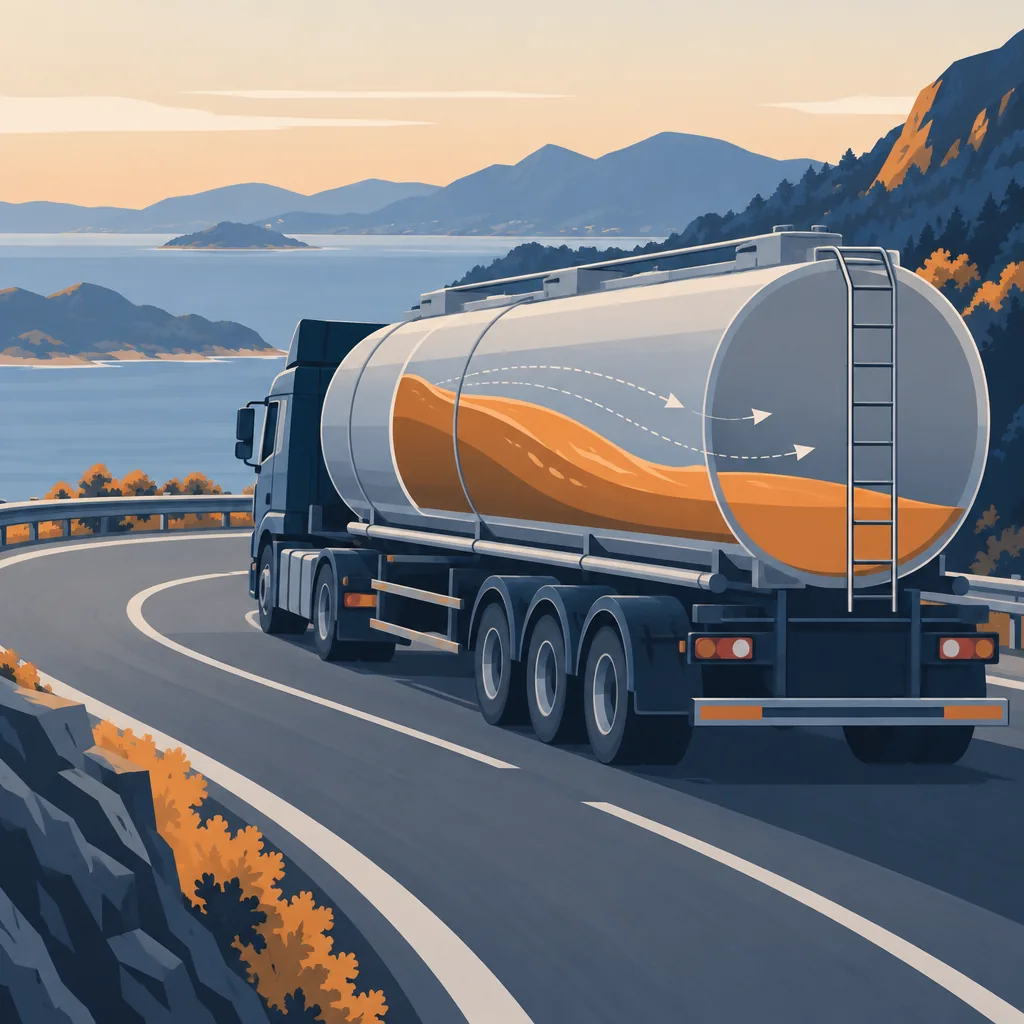
The Tank Vehicles test covers inspecting tank vehicles, driving tank vehicles, surge and liquid movement, baffled and unbaffled tanks, outage, and safe driving rules unique to large liquid loads. Tank vehicles handle very differently from dry-freight vehicles because liquid surge can shove the vehicle in the direction the wave moves.
The Idaho Transportation Department — Driver Services administers this knowledge test as part of its commercial driver license program. To earn the Tank Endorsement (N) on your Idaho CDL, you need to score at least 16 out of 20 on the official version.
Topics covered on this practice test
- Vehicle Dynamics: 5 questions
- Loading: 4 questions
- Adverse Conditions: 3 questions
- Tank Types: 3 questions
- Mountain Driving: 2 questions
- Speed Management: 1 question
- HazMat Driving: 1 question
- Emergency Equipment: 1 question
- Inspection: 1 question
- Emergency Maneuvers: 1 question
- Parking: 1 question
- Operation: 1 question
- Emergencies: 1 question
How to use this practice test
- Read each question carefully. CDL questions are written precisely — small wording differences matter.
- Click an answer choice to check it instantly — right or wrong, you'll see the explanation right away.
- Read the explanation for every question, even ones you got right. The reasoning is more important than the answer.
- Repeat the test until you score 100%. The questions are deterministic per state, so you can track your improvement over multiple sessions.
- Move on to the other endorsement tests for Idaho until you're ready for the official exam.
Tips specific to the Tank Vehicles test
Tank vehicle questions focus on liquid surge, outage, smooth-bore versus baffled tanks, high center of gravity, and the special braking and turning techniques required to keep a partially-loaded tank under control. Expect several questions about leak response and load distribution.