Question 1 of 25 · Operation
What's the proper way to handle a student with special needs?
-
A.
Provide assistance and ensure their safety
-
B.
Refuse to transport
-
C.
Treat them like other students without help
-
D.
Charge extra
Correct answer: A.
Provide appropriate assistance; safety comes first.
Question 2 of 25 · Boarding
When using a wheelchair lift, drivers should:
-
A.
Follow proper procedures and ensure the wheelchair is secured
-
B.
Use the lift quickly
-
C.
Refuse to transport wheelchairs
-
D.
Skip securing the wheelchair
Correct answer: A.
Use the lift correctly and secure the wheelchair before moving.
Question 3 of 25 · Mirrors
What is the importance of using mirrors on a school bus?
-
A.
To monitor blind spots and ensure student safety
-
B.
To check personal appearance
-
C.
For decoration
-
D.
To save fuel
Correct answer: A.
Mirrors are critical for monitoring children entering and leaving the bus.
Question 4 of 25 · Emergency Equipment
What's the importance of using safety equipment?
-
A.
Protects driver and students
-
B.
Required by law
-
C.
Reduces injuries in emergencies
-
D.
All of the above
Correct answer: D.
Safety equipment protects everyone, meets legal requirements, and reduces injury.
Question 5 of 25 · Mirrors
How should drivers handle blind spots?
-
A.
Use mirrors and check before moving
-
B.
Ignore blind spots
-
C.
Drive in the middle lane
-
D.
Use only the driver's side mirror
Correct answer: A.
Mirror checks are critical, especially around children entering or exiting.
Question 6 of 25 · Adverse Conditions
What's the safest way to handle a school bus during a thunderstorm?
-
A.
Pull over to a safe location and wait until the storm passes
-
B.
Continue driving
-
C.
Drive faster to escape
-
D.
Tell students to handle it
Correct answer: A.
Stop in a safe area; resume only when conditions are safe.
Question 7 of 25 · Operation
What's the role of the driver in student behavior?
-
A.
Maintain order and a safe environment
-
B.
Ignore students
-
C.
Be friends with students
-
D.
Enforce school rules only
Correct answer: A.
Maintain a safe environment with calm authority.
Question 8 of 25 · Inspection
What is "post-trip inspection"?
-
A.
An inspection done after the trip ends to identify defects and any students left on board
-
B.
A student survey
-
C.
A fuel check
-
D.
A weekly maintenance
Correct answer: A.
Walk through the bus after every run to find defects and check for students.
Question 9 of 25 · Loading
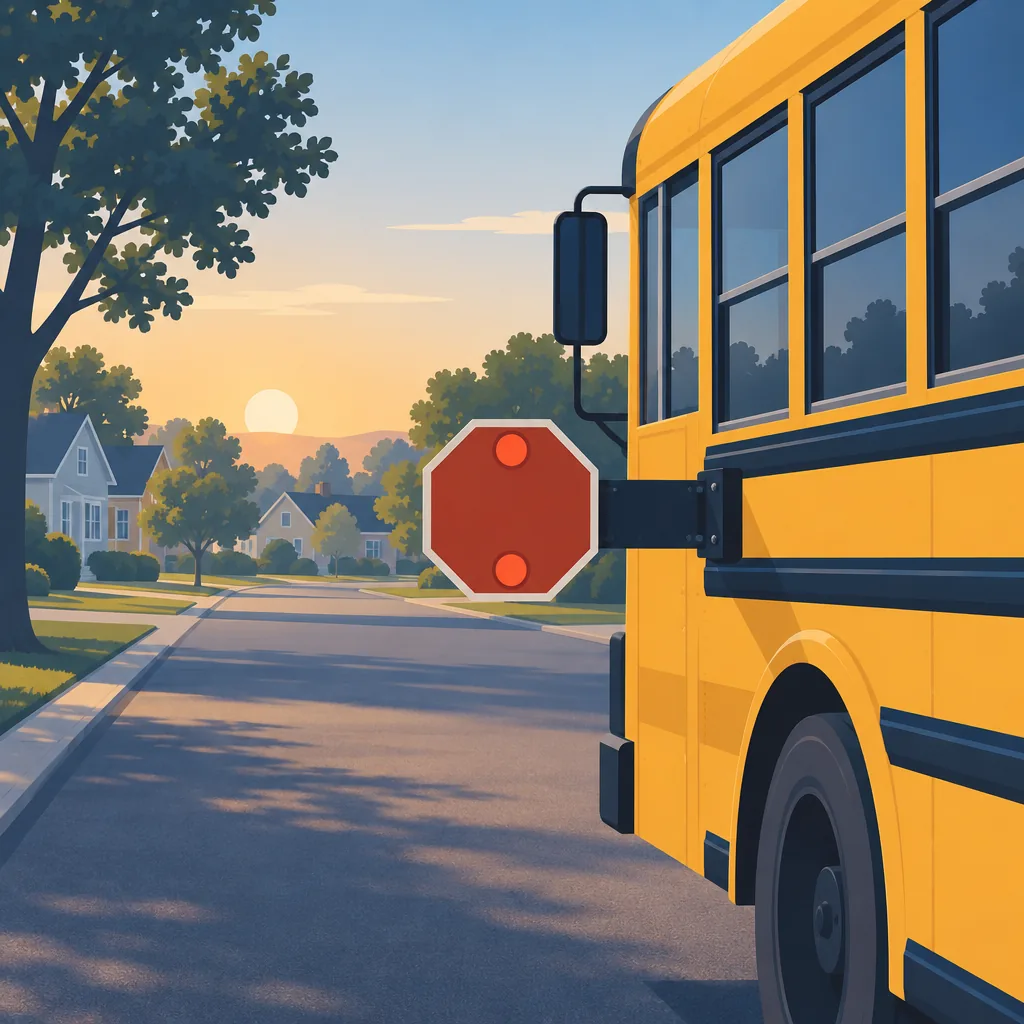
When are flashing red lights and stop arm extended?
-
A.
When the bus is stopped to load or unload students
-
B.
When the bus is moving
-
C.
When the bus is parked
-
D.
When the engine is off
Correct answer: A.
Lights and stop arm activate during student loading and unloading.
Question 10 of 25 · Emergencies
How often should school bus drivers practice evacuation procedures?
-
A.
Regularly, as required by state regulations
-
B.
Once a year
-
C.
Never
-
D.
Only when an emergency happens
Correct answer: A.
Most states require regular evacuation drills with students.
Question 11 of 25 · Loading
What's the proper procedure for loading students?
-
A.
Activate flashing lights and stop arm, then allow students to board
-
B.
Drive forward to greet students
-
C.
Honk to alert students
-
D.
Open the door immediately
Correct answer: A.
Activate warning lights and stop arm before opening the door.
Question 12 of 25 · Emergencies
How should drivers handle a student becoming ill?
-
A.
Stop in a safe area and call for medical help
-
B.
Continue to school
-
C.
Tell the student to get off
-
D.
Ignore the student
Correct answer: A.
Stop safely and contact medical help if needed.
Question 13 of 25 · Loading
What's the maximum number of standees allowed on a school bus?
-
A.
Generally not allowed
-
B.
Same as seated passengers
-
C.
Always 10
-
D.
No limit
Correct answer: A.
Standees are generally not allowed on school buses for safety.
Question 14 of 25 · Emergencies
What's the role of emergency exits on a school bus?
-
A.
To provide alternate evacuation routes in emergencies
-
B.
For luggage
-
C.
For ventilation
-
D.
For maintenance
Correct answer: A.
Emergency exits give children additional ways out in a crash or fire.
Question 15 of 25 · Loading
How should drivers handle the bus during student loading and unloading?
-
A.
Activate warning lights and stop arm
-
B.
Wait until all students are clear before moving
-
C.
Use mirrors to monitor students
-
D.
All of the above
Correct answer: D.
Warning devices, careful waiting, and mirror checks all protect students.
Question 16 of 25 · Adverse Conditions
What's the safest way to handle a school bus on a wet road?
-
A.
Reduce speed and increase following distance
-
B.
Drive at posted speed
-
C.
Use engine retarder
-
D.
Lock the brakes
Correct answer: A.
Slower speeds and more space; engine retarder can cause skids on wet roads.
Question 17 of 25 · Communication
What's the proper way to communicate with students?
-
A.
Clear announcements about safety and rules
-
B.
Don't communicate
-
C.
Yell at students
-
D.
Use only hand signals
Correct answer: A.
Clear and respectful communication keeps students safe and informed.
Question 18 of 25 · Operation
What's the role of the school bus driver in student safety?
-
A.
Maintain a safe environment and respond to emergencies
-
B.
Collect fares
-
C.
Drive without regard to students
-
D.
Enforce school rules only
Correct answer: A.
Drivers protect students throughout boarding, transport, and unloading.
Question 19 of 25 · Following Distance
What's the safest way to handle a school bus in heavy traffic?
-
A.
Maintain extra following distance and signal early
-
B.
Speed up to keep with traffic
-
C.
Drive aggressively
-
D.
Use the shoulder
Correct answer: A.
Extra space and clear signals reduce risk in heavy traffic.
Question 20 of 25 · Loading
What's the maximum number of students that can be in a school bus?
-
A.
Determined by the bus's seating capacity
-
B.
Always 50
-
C.
No limit
-
D.
Always 75
Correct answer: A.
Capacity depends on the bus model and seating configuration.
Question 21 of 25 · Emergencies
How should drivers handle a bus breakdown?
-
A.
Move to a safe area, set warning devices, and call for help
-
B.
Continue driving
-
C.
Tell students to walk
-
D.
Leave the bus
Correct answer: A.
Pull off safely, set warning triangles, and contact dispatch and emergency services.
Question 22 of 25 · Inspection
What's the importance of pre-trip inspection on a school bus?
-
A.
To identify defects before driving children
-
B.
To comply with regulations
-
C.
To ensure student safety
-
D.
All of the above
Correct answer: D.
Pre-trips identify defects, comply with rules, and protect children.
Question 23 of 25 · Inspection
When must school bus drivers check the brakes?
-
A.
Before each trip and at any time the brakes are suspect
-
B.
Once a week
-
C.
Only at maintenance
-
D.
Once a month
Correct answer: A.
Inspect brakes every pre-trip and any time something seems wrong.
Question 24 of 25 · Emergencies
What's the role of the driver during a school bus evacuation?
-
A.
Direct students to safety and call for help
-
B.
Drive away
-
C.
Tell students to handle it
-
D.
Stay in the bus
Correct answer: A.
Lead students to safety and contact emergency services.
Question 25 of 25 · Emergencies
What's the proper way to handle a fire on a school bus?
-
A.
Stop in a safe area, evacuate students, and call for help
-
B.
Continue to school
-
C.
Tell students to put out the fire
-
D.
Drive faster
Correct answer: A.
Stop, evacuate quickly, and call emergency services.
About the School Bus Test
The School Bus test covers danger zones and use of mirrors, loading and unloading, emergency exit and evacuation, railroad-highway grade crossings, student management, antilock brake systems, and special safety considerations. School bus drivers must also pass the Passenger Transport test.
The Alabama Law Enforcement Agency — Driver License Division administers this knowledge test as part of its commercial driver license program. To earn the School Bus Endorsement (S) on your Alabama CDL, you need to score at least 16 out of 20 on the official version.
Topics covered on this practice test
- Emergencies: 6 questions
- Loading: 5 questions
- Operation: 3 questions
- Inspection: 3 questions
- Mirrors: 2 questions
- Adverse Conditions: 2 questions
- Boarding: 1 question
- Emergency Equipment: 1 question
- Communication: 1 question
- Following Distance: 1 question
How to use this practice test
- Read each question carefully. CDL questions are written precisely — small wording differences matter.
- Click an answer choice to check it instantly — right or wrong, you'll see the explanation right away.
- Read the explanation for every question, even ones you got right. The reasoning is more important than the answer.
- Repeat the test until you score 100%. The questions are deterministic per state, so you can track your improvement over multiple sessions.
- Move on to the other endorsement tests for Alabama until you're ready for the official exam.
Tips specific to the School Bus test
School Bus drivers need both the Passenger and School Bus endorsements. Most school bus questions cover the danger zone, mirror checks, loading and unloading procedures, evacuation, railroad crossings, and student behavior management. Topics like the brake-door interlock and post-trip child-check sweeps appear frequently.