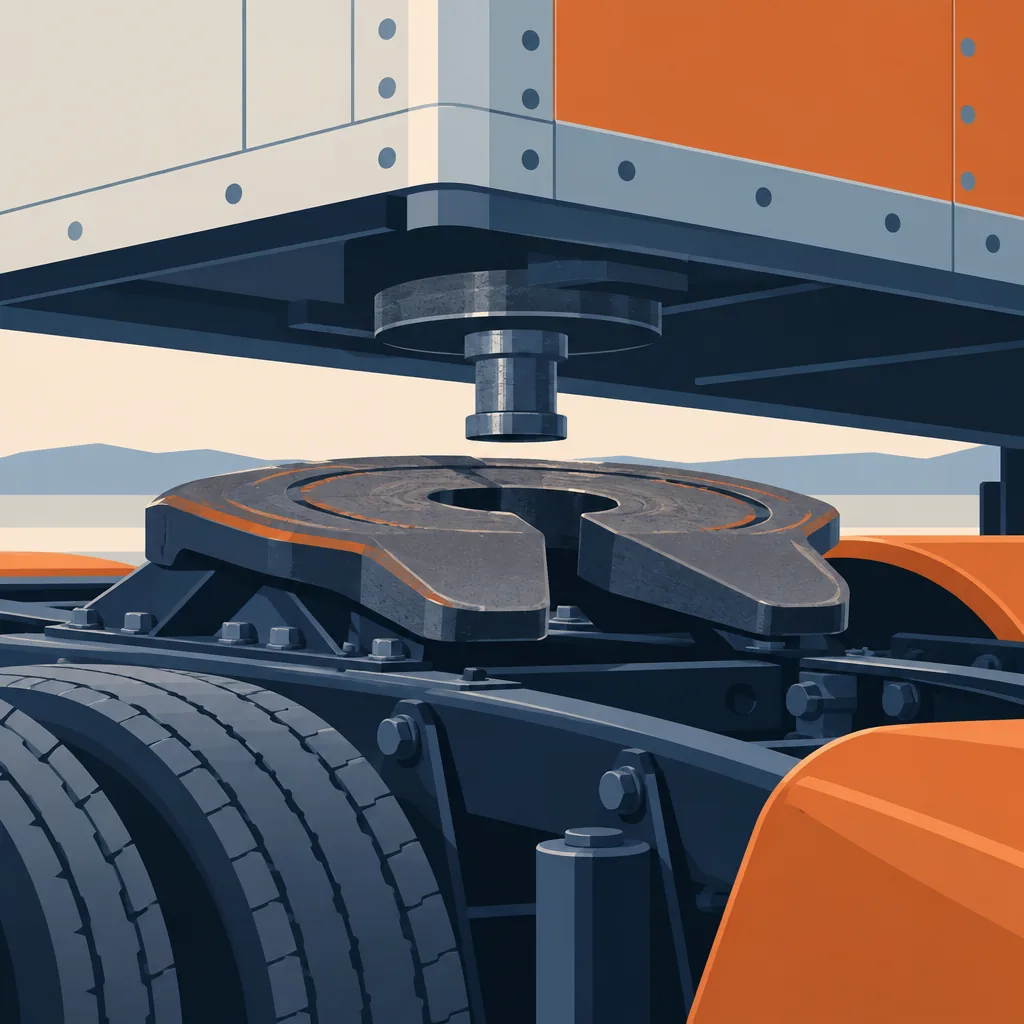
Question 1 of 25 · Skids
What is the result of a "trailer jackknife"?
-
A.
Trailer continues straight ahead
-
B.
Trailer swings out and tractor pivots
-
C.
Trailer comes to a quick safe stop
-
D.
Trailer disengages
Correct answer: B.
In a trailer jackknife, the trailer swings out, often into adjacent lanes.
Question 2 of 25 · Coupling
What should you do before connecting air lines?
-
A.
Clean the rubber seals on the glad hands
-
B.
Lubricate them with oil
-
C.
Replace the seals every trip
-
D.
Heat them up
Correct answer: A.
Clean glad hand seals before connecting to ensure a good air seal.
Question 3 of 25 · Inspection
When should you check trailer brakes during operation?
-
A.
First few miles after coupling
-
B.
Every fuel stop
-
C.
Just at the end of the trip
-
D.
Never during the trip
Correct answer: A.
Test trailer brakes early in the trip to make sure they are functioning correctly.
Question 4 of 25 · Skids
What can cause a trailer skid in a combination vehicle?
-
A.
Locked trailer wheels and over-application of brakes
-
B.
Light loads on the trailer
-
C.
Tight steering at low speed
-
D.
High pressure in steering tires
Correct answer: A.
Locked trailer wheels cause trailer skid; reduce brake pressure to recover.
Question 5 of 25 · Coupling
Before backing under a trailer, you should:
-
A.
Make sure the trailer brakes are set and the trailer is at the correct height
-
B.
Disconnect the air lines
-
C.
Lower the landing gear
-
D.
Engage the parking brake
Correct answer: A.
Confirm trailer brakes are locked and trailer height matches the fifth wheel.
Question 6 of 25 · Vehicle Dynamics
Which of these is true about the front trailer of a doubles or triples?
-
A.
It is less likely to overturn
-
B.
It is more stable
-
C.
It is more likely to overturn than the rear trailer
-
D.
It does not need brakes
Correct answer: A.
The front trailer in a combination is generally more stable than the rear trailer.
Question 7 of 25 · Coupling
You should NEVER:
-
A.
Back under a trailer at an angle
-
B.
Inspect the fifth wheel
-
C.
Use the parking brake
-
D.
Tug-test the kingpin
Correct answer: A.
Backing at an angle can damage the kingpin or push the trailer sideways.
Question 8 of 25 · Skids
What is "tractor jackknife"?
-
A.
Tractor drive wheels skid and the trailer pushes the tractor sideways
-
B.
Trailer wheels skid
-
C.
Steering wheels skid
-
D.
Engine fails
Correct answer: A.
When drive wheels skid, the trailer can push the tractor sideways into a jackknife.
Question 9 of 25 · Inspection
Which is true about gladhand seals?
-
A.
They should be replaced if cracked or damaged
-
B.
They never need replacement
-
C.
They are the same as electrical connections
-
D.
They are always made of metal
Correct answer: A.
Replace damaged or worn rubber seals to keep air from leaking at the gladhands.
Question 10 of 25 · Skids
Tractor jackknife occurs when:
-
A.
Drive wheels lose traction and skid
-
B.
The trailer wheels lock
-
C.
The trailer slides forward
-
D.
Steering wheels lock
Correct answer: A.
Drive wheels skidding cause tractor jackknife; trailer wheels skidding cause trailer jackknife.
Question 11 of 25 · Coupling
What does a "low coupling" condition look like?
-
A.
Trailer is too high above the fifth wheel
-
B.
Trailer is at the right height
-
C.
Trailer is too low and tractor frame can hit the trailer
-
D.
Trailer is angled to the right
Correct answer: C.
A trailer too low can damage the tractor frame as it slides under it.
Question 12 of 25 · Vehicle Dynamics
What is "off-tracking"?
-
A.
When the rear wheels follow a different path than the front wheels
-
B.
When the trailer slides off the road
-
C.
When the trailer is improperly loaded
-
D.
A type of fifth wheel
Correct answer: A.
In turns, rear wheels travel a smaller arc than the front, causing off-tracking.
Question 13 of 25 · Coupling
When uncoupling, you should:
-
A.
Lower the landing gear before pulling the kingpin release
-
B.
Lift the trailer with the fifth wheel
-
C.
Release the parking brake
-
D.
Rev the engine
Correct answer: A.
Lower the landing gear so the trailer is supported before disconnecting the kingpin.
Question 14 of 25 · Vehicle Dynamics
Empty trucks have what kind of stopping distance compared to fully loaded ones?
-
A.
Shorter
-
B.
Same
-
C.
Longer
-
D.
Half
Correct answer: C.
Empty rigs have less traction on drive axles and require greater stopping distance.
Question 15 of 25 · Coupling
When uncoupling, what is the final step?
-
A.
Lower the landing gear and disconnect electrical cord and air lines
-
B.
Drive forward immediately
-
C.
Set the parking brake on the tractor only
-
D.
Engage the trailer brakes only
Correct answer: A.
After raising the fifth wheel jaws and pulling forward, disconnect lines and lower landing gear.
Question 16 of 25 · Cargo
What can cause a high center of gravity?
-
A.
Loading cargo too low
-
B.
Loading cargo too high or unevenly
-
C.
Driving too slowly
-
D.
Empty trailers
Correct answer: B.
Stacking cargo too high or loading unevenly raises the center of gravity and rollover risk.
Question 17 of 25 · Inspection
When inspecting your trailer's wheels, what should you look for?
-
A.
Loose or missing nuts
-
B.
Cracked or broken wheel rims
-
C.
Bent or broken studs
-
D.
All of the above
Correct answer: D.
Inspect for loose nuts, cracks, bent studs, and other defects on every pre-trip.
Question 18 of 25 · Coupling
When coupling, what should you do after the fifth wheel locks onto the kingpin?
-
A.
Pull the tractor forward gently to make sure the kingpin is locked
-
B.
Disconnect the air lines
-
C.
Drive away immediately
-
D.
Release the trailer parking brake first
Correct answer: A.
Tug-test by gently pulling forward with the trailer brakes set to confirm the lock.
Question 19 of 25 · Following Distance
How can you reduce risk of rear-end collisions?
-
A.
Maintain safe following distances and watch for slowing traffic
-
B.
Drive at the speed limit always
-
C.
Use mirrors only at night
-
D.
Avoid signaling
Correct answer: A.
Use safe following distances and watch ahead so you have time to slow down.
Question 20 of 25 · Inspection
You should inspect the rear of the trailer for:
-
A.
Cracked or missing lights
-
B.
Lights and reflectors are clean and operational
-
C.
Mud flap condition
-
D.
All of the above
Correct answer: D.
Check lights, reflectors, mud flaps, and license plate during pre-trip.
Question 21 of 25 · Inspection
Air leaks during pre-trip can be detected by:
-
A.
Listening for hissing
-
B.
Watching the air gauges drop
-
C.
Visually inspecting hoses and fittings
-
D.
All of the above
Correct answer: D.
Use multiple methods — listening, watching gauges, and visual inspection — to detect leaks.
Question 22 of 25 · Combination Air
Trailer brakes are required to be:
-
A.
Adjusted properly and matched to tractor brakes
-
B.
Stronger than tractor brakes
-
C.
Disengaged on level roads
-
D.
Off when empty
Correct answer: A.
Trailer brakes must be in proper adjustment and balance with tractor brakes.
Question 23 of 25 · Mountain Driving
When should you use lower gears?
-
A.
On steep upgrades and downgrades
-
B.
In flat terrain
-
C.
In stop-and-go traffic only
-
D.
Never in a combination vehicle
Correct answer: A.
Use lower gears on grades to maintain torque and engine braking.
Question 24 of 25 · Skids
How can you correct a tractor jackknife?
-
A.
Apply the brakes harder
-
B.
Steer in the direction of the skid and accelerate gently
-
C.
Stop steering input
-
D.
Release the brakes and counter-steer
Correct answer: D.
Release the brakes to regain traction; counter-steer carefully to recover.
Question 25 of 25 · Combination Air
When the trailer breaks away or loses air pressure, the trailer brakes should:
-
A.
Release
-
B.
Apply automatically
-
C.
Vibrate
-
D.
Disengage
Correct answer: B.
A loss of air should automatically apply the trailer brakes via the emergency system.
About the Combination Vehicles Test
The Combination Vehicles test covers driving combination vehicles safely, combination vehicle air brakes, antilock brake systems, coupling and uncoupling, and inspecting a combination vehicle. Combination vehicles are usually heavier, longer, and require more driving skill than single commercial vehicles. They are also more likely to roll over and jackknife.
The Mississippi Department of Public Safety — Driver Services administers this knowledge test as part of its commercial driver license program. To earn the Combination Vehicles on your Mississippi CDL, you need to score at least 16 out of 20 on the official version.
Topics covered on this practice test
- Coupling: 7 questions
- Skids: 5 questions
- Inspection: 5 questions
- Vehicle Dynamics: 3 questions
- Combination Air: 2 questions
- Cargo: 1 question
- Following Distance: 1 question
- Mountain Driving: 1 question
How to use this practice test
- Read each question carefully. CDL questions are written precisely — small wording differences matter.
- Click an answer choice to check it instantly — right or wrong, you'll see the explanation right away.
- Read the explanation for every question, even ones you got right. The reasoning is more important than the answer.
- Repeat the test until you score 100%. The questions are deterministic per state, so you can track your improvement over multiple sessions.
- Move on to the other endorsement tests for Mississippi until you're ready for the official exam.
Tips specific to the Combination Vehicles test
Combination Vehicles questions cover off-tracking, jackknifing, coupling and uncoupling, the fifth wheel, kingpin, glad hands, landing gear, and the special air-brake considerations for tractor-trailer combinations. Expect detailed step-by-step coupling questions.